CATESOL Book Review: Hidden in Blackness: Being Black and Being an Immigrant in U.S. Schools and Colleges by Chrystal A. George Mwangi and Adaurennaya C. Onyewuenyi, Forward by Janice Fournillier
07/26/2026
Michelle Skowbo
By Noemí Castelo Veiga and Jonas Vilaire
Introduction to the Book Review
Academic Connections is an educational network of scholars from various countries organized informally with the goal of expanding equitable access to global learning through academic collaboration between students and educators via Collaborative Online International Learning (COIL). Quarterly Book Reading Groups, along with other events, are among its main activities and provide ongoing learning spaces focused on debate, intercultural understanding, reflective dialogue, and collaborative analysis.
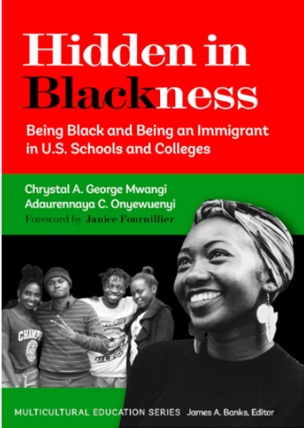
The latest book this reading group focused on was Hidden in Blackness: Being Black and Being an Immigrant in U.S. Schools and Colleges, which examines the complexities with being Black and immigrant in the United States. This book is part of the Multicultural Education Series and was published in 2025 by Chrystal A. George Mwangi and Adaurennaya C. Onyewuenyi. Across nine chapters, the authors explore the experiences, trajectories, and outcomes of Black immigrants in the U.S. P-20 education system (that is, from preschool through higher education), which can be affected by race, identity, and nationality.
The book aims to foster culturally sensitive support for these students, their families, and their communities, by “complicating” the understanding of the concepts of Blackness and immigration.
Chapter 1. Introduction: Complicating Blackness and Immigration
In the first chapter, the authors—whose identities are inextricably linked to Black immigrant communities—outline the main objective of their book: To move away from essentializing students who are both immigrants and Black, thereby refining the understanding of Blackness and immigrant identity within the U.S. educational context.
They then provide a brief overview of the major immigration policies implemented in the United States between 1965 and early 2020, which have impacted and continue to impact the flows of Black immigrants arriving in the country with many of them being from: African, Caribbean, and Afro-Latin immigrant populations.
The introduction concludes with a brief section in which the authors reflect on their experiences and identities as native insider researchers, acknowledging that these reflect only a small part of the vast diversity represented within the Black immigrant population.
Chapter 2. Lifting the Veil on the Landscape of Black Immigrant and U.S. Education Scholarship
In this chapter, the authors provide an analytical overview of existing research on the educational trajectories of Black immigrants in the United States. Their analysis highlights a scarcity of publications on the lives of this population in the U.S. context and demonstrates how their experiences have been shaped and empirically studied. A key point of this chapter is the concept of “double invisibility” experienced by Black immigrants in American society: a lack of recognition and systemic marginalization. This stigma stems from their position at the intersection of two categories: being Black and being an immigrant.
While the authors argue that these immigrants are often homogenized by the educational system, they also note how this is frequently used to reinforce meritocracy and the myth of the “model minority.” These narratives serve not only to divide Black people across generations and Black immigrants (racial divisions and intragroup racial tensions), but also to deny the existence of racism within the educational system. According to the book, Black immigrants do not transcend anti-Black racist structures or the process of racialization in U.S. schools. Rather, this population activates networks and resources to navigate the educational system that may be (di)similar to those of their multigenerational African American peers and those of their non-Black immigrant peers.
Chapter 3. Complicating Racial Identity Development
This chapter provides an overview of the two main models of Black identity development in the U.S. context and their respective measurement instruments (George Mwangi & Onyewuenyi, 2025):
All of these models have significant limitations when applied to Black immigrants: They were developed within a U.S. centered racial context and reflect the multigenerational socialization of African Americans regarding race. Consequently, they have failed to capture Black identity among immigrants, as they have treated the United States as the origin of Black identity. Furthermore, Black immigrants have a completely different experience, shaped by their country of origin and, therefore, by their racialization, stemming from a country with a predominantly Black population—in stark contrast to the United States, where African Americans remain a minority.
Identity formation is a fluid, dynamic process in which other contextual factors—such as the racial climate on campus or classroom discussions of race and racism—influence the way Black immigrants understand, experience, and define their Blackness. Hence, the authors advocate for a multidimensional and intersectional approach to more fully understand the various elements that shape identity formation among these population groups.
Chapter 4. Complicating the K-12 Education System and Structures
This chapter discusses the structural, financial, cultural, and logistical factors within K-12 education (that is, public elementary and secondary schools) that shape, influence, and determine the educational trajectories, experiences, and outcomes of Black immigrant students. Specifically, the authors identify four main factors:
Chapter 5. Complicating K-12 Social Support and Resources: Black Immigrant Youth Navigating Gatekeepers and Shepherds
This chapter focuses on the relationships that Black immigrant students have both inside and outside elementary and secondary schools, exploring the strategies of agency they use to navigate these culturally diverse interactions (for example, language and cultural brokering or code-switching) and the academic and socio-emotional impacts of these relational dynamics, which shape their own educational experience.
Specifically, the authors note that these children and youth may perceive their family (both the nuclear family and the extended family living in the United States and in their countries of origin) and community, friends and peers, and teachers, school counselors, and school administrators as gatekeepers, shepherds, or both—depending on whether they control and restrict their access to educational resources and opportunities or provide support, advocacy, and guidance. In this regard, educational expectations; racial, ethnic, and cultural socialization; family, community, and school support; intra-racial peer dynamics (which encompass both support and exclusion and avoidance); peer discrimination; educational stereotypes about Black immigrants; student participation; and academic monitoring shape their experiences in very diverse ways as they navigate through, between, and within their family environments, peer groups, and schools.
Chapter 6. Complicating Access to Higher Education
This chapter describes how Black immigrant students navigate the college selection process, emphasizing the factors that can act as barriers or sources of support, as well as their motivations, capital, resources, and networks—all of which are related to their racial, ethnic, and immigrant identities.
The authors note the existence of a success narrative regarding Black immigrants’ access to higher education in the United States, particularly concerning their admission to elite universities. However, they highlight how this narrative reinforces a stereotypical representation of Black minorities in higher education—the “model minority” myth—which perpetuates intra-racial tensions among multigenerational African Americans and obscures the challenges many members of this population face in accessing higher education.
Among the main barriers this population faces when trying to gain admission to college are: cost, a lack of knowledge about college, a K-12 environment with little support and insufficient or scarce resources, and challenges within the family environment.
Chapter 7. Complicating Student Experiences in Higher Education
This chapter continues to focus on the context of higher education but delves deeper into the experiences of Black immigrants during their time at U.S. universities. It emphasizes how these young people’s experiences in higher education are complicated by the fact that universities often overlook their presence—whether as immigrants and international students or as Black individuals—which results in less support for their academic and personal experiences.
In line with the above, throughout the chapter the authors describe how adaptation to college—where strong social networks, campus support and resources, belief in one’s academic abilities and skills, and external validation of one’s capacity to succeed—contributes to student persistence. Of particular relevance are college experiences related to the campus climate, which are strongly linked to inclusion and diversity practices; academic and classroom experiences, often marked by a lack of sensitivity on the part of faculty and an increase in the internalization and externalization of stereotypes; and experiences of peer engagement through coalition-building, exclusion, or seeking distance and creating their own spaces, which can affect their perspectives and college experiences in different ways.
Therefore, the educational trajectories of Black immigrant students in higher education are shaped by their identities, the types of institutions they attend, their educational experiences outside the United States, and other factors: there is no single way to understand their experiences.
Chapter 8. Complicating Education and Workforce Outcomes
After analyzing and exploring in depth the experiences of Black immigrant students in the U.S. P-20 education system, this chapter includes the main educational and employment outcomes for this population group, highlighting how the U.S. education system can influence these outcomes, either by reinforcing them or by disrupting them.
With respect to educational outcomes, the authors highlight the successes achieved by the Black immigrant population within the U.S. system, particularly in contrast to their multigenerational African American peers and other non-Black immigrant groups: higher high school graduation rates, lower dropout rates, and greater persistence in higher education. However, as the authors point out, it is necessary to look beyond these generalizations, which have been fueled by a belief in and blind faith in the American Dream, where success is seen as a means of mitigating or overcoming the racial discrimination and xenophobia experienced in U.S. society. These initial beliefs about meritocracy fade over time across generations, as these populations experience structural racism and other forms of oppression in the United States. Similarly, selectivity also plays a crucial role in academic outcomes through parents’ educational attainment, social class, and economic status; compared to their peers from their countries of origin, Black immigrants who migrate have twice the level of education, greater economic capital, and a better command of English. In addition, a strong sense of ethnic identity—that is, an understanding and acceptance of one’s own ethnicity—is also associated with higher educational aspirations, better qualifications, and high academic self-efficacy.
Concerning labor market outcomes, the authors note that Black immigrants have one of the highest labor force participation rates among immigrant groups. However, many are employed in low-wage service occupations, although healthcare is one of the main occupational sectors for Black immigrants, with self-employment and small business ownership also standing out. According to the authors, these outcomes in economic and occupational mobility are a direct consequence of—or are strongly influenced by—the following: a) white favoritism, that is, when white employers view Black immigrants as more easily assimilated into white norms than multigenerational African Americans in order to assert that racism does not exist; b) selectivity and human capital—that is, the significant characteristics or traits that many bring with them when they immigrate; c) imperfect transferability and underemployment, which relate to the lack of transferability or value of educational credentials and professional experiences gained abroad; and d) racial discrimination and queuing, which describes how exclusion, a hostile racial climate, and underrepresentation amplify the difficult racial realities faced by this population group in various fields of work.
Chapter 9. Conclusion: Hidden No More: The Black Diasporic Illumination Framework
The concluding chapter ties together the main themes of the previous chapters and offers a framework for Black Diasporic Illumination (BDI). This framework aims to foster understanding of and support for Black immigrant students navigating the U.S. educational system, illustrating how these students’ processes of racialization and deculturalization—as well as their opportunities for success—are influenced by their microsystems’ responses to macrosystem ideologies and perceptions of their abilities and merits. The framework is grounded in four integrated theoretical and conceptual foundations: the foundations of sociocultural ecology; the foundations of ethnic-racial identity, acculturation, and racial socialization; the foundations of assets orientation; and the foundations of critical constructions of race and racism.
The authors conclude the chapter by offering implications and future opportunities for researchers, policymakers, and education professionals concerning Black immigrants. In this regard, they advocate for the need for scholars and educators to re-cognize how immigration, race, and equity are reflected in their educational and employment trajectories and outcomes, as Black immigrants represent a growing and diverse population within the P-20 system in the United States.
Conclusion of the Book Review
The book helps to bridge the knowledge gap in the scientific literature regarding a minoritized minority group in the United States: Black immigrants, who navigate within and through the U.S. system while developing multiple identities. Often hidden by their Blackness, they seek to distance themselves from multigenerational African Americans in order to distinguish themselves as a “model minority” in the eyes of the majority society.
Throughout the chapters, the authors undoubtedly provide a roadmap for researchers and scholars to recognize and amplify the diverse trajectories and experiences of this population group in U.S. elementary, secondary, and higher education institutions, where they are often essentialized under a single category, whether based on race or foreign origin. Additionally, the BDI serves as a useful resource for educators, teachers, and school administrators to implement culturally relevant educational practices in U.S. P-20 education.
References
George Mwangi, C. A., & Onyewuenyi, A. C. (2025). Hidden in Blackness: Being Black and being an immigrant in U.S. schools and colleges. Teachers College Press.
Michelle Skowbo
Hidden in Blackness: Being Black and Being an Immigrant in U.S. Schools and Colleges by Chrystal A. George Mwangi and Adaurennaya C. Onyewuenyi, Forward by Janice Fournillier
By Noemí Castelo Veiga and Jonas Vilaire
Introduction to the Book Review
Academic Connections is an educational network of scholars from various countries organized informally with the goal of expanding equitable access to global learning through academic collaboration between students and educators via Collaborative Online International Learning (COIL). Quarterly Book Reading Groups, along with other events, are among its main activities and provide ongoing learning spaces focused on debate, intercultural understanding, reflective dialogue, and collaborative analysis.
The latest book this reading group focused on was Hidden in Blackness: Being Black and Being an Immigrant in U.S. Schools and Colleges, which examines the complexities with being Black and immigrant in the United States. This book is part of the Multicultural Education Series and was published in 2025 by Chrystal A. George Mwangi and Adaurennaya C. Onyewuenyi. Across nine chapters, the authors explore the experiences, trajectories, and outcomes of Black immigrants in the U.S. P-20 education system (that is, from preschool through higher education), which can be affected by race, identity, and nationality.
The book aims to foster culturally sensitive support for these students, their families, and their communities, by “complicating” the understanding of the concepts of Blackness and immigration.
Chapter 1. Introduction: Complicating Blackness and Immigration
In the first chapter, the authors—whose identities are inextricably linked to Black immigrant communities—outline the main objective of their book: To move away from essentializing students who are both immigrants and Black, thereby refining the understanding of Blackness and immigrant identity within the U.S. educational context.
They then provide a brief overview of the major immigration policies implemented in the United States between 1965 and early 2020, which have impacted and continue to impact the flows of Black immigrants arriving in the country with many of them being from: African, Caribbean, and Afro-Latin immigrant populations.
The introduction concludes with a brief section in which the authors reflect on their experiences and identities as native insider researchers, acknowledging that these reflect only a small part of the vast diversity represented within the Black immigrant population.
Chapter 2. Lifting the Veil on the Landscape of Black Immigrant and U.S. Education Scholarship
In this chapter, the authors provide an analytical overview of existing research on the educational trajectories of Black immigrants in the United States. Their analysis highlights a scarcity of publications on the lives of this population in the U.S. context and demonstrates how their experiences have been shaped and empirically studied. A key point of this chapter is the concept of “double invisibility” experienced by Black immigrants in American society: a lack of recognition and systemic marginalization. This stigma stems from their position at the intersection of two categories: being Black and being an immigrant.
While the authors argue that these immigrants are often homogenized by the educational system, they also note how this is frequently used to reinforce meritocracy and the myth of the “model minority.” These narratives serve not only to divide Black people across generations and Black immigrants (racial divisions and intragroup racial tensions), but also to deny the existence of racism within the educational system. According to the book, Black immigrants do not transcend anti-Black racist structures or the process of racialization in U.S. schools. Rather, this population activates networks and resources to navigate the educational system that may be (di)similar to those of their multigenerational African American peers and those of their non-Black immigrant peers.
Chapter 3. Complicating Racial Identity Development
This chapter provides an overview of the two main models of Black identity development in the U.S. context and their respective measurement instruments (George Mwangi & Onyewuenyi, 2025):
- Cross’s Nigrescence model and the Racial Identity Attitude Scale (RIAS-B) and the Cross Racial Identity Scale (CRIS) as measurement tools.
- The Multidimensional Model of Racial Identity (MMRI) and the Multidimensional Inventory of Black Identity (MIBI) as the measurement tool.
All of these models have significant limitations when applied to Black immigrants: They were developed within a U.S. centered racial context and reflect the multigenerational socialization of African Americans regarding race. Consequently, they have failed to capture Black identity among immigrants, as they have treated the United States as the origin of Black identity. Furthermore, Black immigrants have a completely different experience, shaped by their country of origin and, therefore, by their racialization, stemming from a country with a predominantly Black population—in stark contrast to the United States, where African Americans remain a minority.
Identity formation is a fluid, dynamic process in which other contextual factors—such as the racial climate on campus or classroom discussions of race and racism—influence the way Black immigrants understand, experience, and define their Blackness. Hence, the authors advocate for a multidimensional and intersectional approach to more fully understand the various elements that shape identity formation among these population groups.
Chapter 4. Complicating the K-12 Education System and Structures
This chapter discusses the structural, financial, cultural, and logistical factors within K-12 education (that is, public elementary and secondary schools) that shape, influence, and determine the educational trajectories, experiences, and outcomes of Black immigrant students. Specifically, the authors identify four main factors:
- The physical characteristics of schools—that is, both their racial and economic composition and their geographic location—where residential segregation becomes a factor that shapes the sociopolitical context of the school environment.
- The institutional and disciplinary policies that guide educational practices and that may foster or reinforce racism and xenophobia.
- The practice of academic tracking, which seeks to place students on different educational pathways based on multiple criteria and processes that vary from state to state (General Education, Special Education Programs, English Language Learner Programs, Honors and Advanced Placement, Dual Enrollment, etc.). This practice can significantly stigmatize the educational experience of Black immigrant students.
- The curriculum (content, materials, and standards) and pedagogy (instructional methods), since what and how are taught strongly influence and shape these students’ connection to academic knowledge and the school environment.
Chapter 5. Complicating K-12 Social Support and Resources: Black Immigrant Youth Navigating Gatekeepers and Shepherds
This chapter focuses on the relationships that Black immigrant students have both inside and outside elementary and secondary schools, exploring the strategies of agency they use to navigate these culturally diverse interactions (for example, language and cultural brokering or code-switching) and the academic and socio-emotional impacts of these relational dynamics, which shape their own educational experience.
Specifically, the authors note that these children and youth may perceive their family (both the nuclear family and the extended family living in the United States and in their countries of origin) and community, friends and peers, and teachers, school counselors, and school administrators as gatekeepers, shepherds, or both—depending on whether they control and restrict their access to educational resources and opportunities or provide support, advocacy, and guidance. In this regard, educational expectations; racial, ethnic, and cultural socialization; family, community, and school support; intra-racial peer dynamics (which encompass both support and exclusion and avoidance); peer discrimination; educational stereotypes about Black immigrants; student participation; and academic monitoring shape their experiences in very diverse ways as they navigate through, between, and within their family environments, peer groups, and schools.
Chapter 6. Complicating Access to Higher Education
This chapter describes how Black immigrant students navigate the college selection process, emphasizing the factors that can act as barriers or sources of support, as well as their motivations, capital, resources, and networks—all of which are related to their racial, ethnic, and immigrant identities.
The authors note the existence of a success narrative regarding Black immigrants’ access to higher education in the United States, particularly concerning their admission to elite universities. However, they highlight how this narrative reinforces a stereotypical representation of Black minorities in higher education—the “model minority” myth—which perpetuates intra-racial tensions among multigenerational African Americans and obscures the challenges many members of this population face in accessing higher education.
Among the main barriers this population faces when trying to gain admission to college are: cost, a lack of knowledge about college, a K-12 environment with little support and insufficient or scarce resources, and challenges within the family environment.
Chapter 7. Complicating Student Experiences in Higher Education
This chapter continues to focus on the context of higher education but delves deeper into the experiences of Black immigrants during their time at U.S. universities. It emphasizes how these young people’s experiences in higher education are complicated by the fact that universities often overlook their presence—whether as immigrants and international students or as Black individuals—which results in less support for their academic and personal experiences.
In line with the above, throughout the chapter the authors describe how adaptation to college—where strong social networks, campus support and resources, belief in one’s academic abilities and skills, and external validation of one’s capacity to succeed—contributes to student persistence. Of particular relevance are college experiences related to the campus climate, which are strongly linked to inclusion and diversity practices; academic and classroom experiences, often marked by a lack of sensitivity on the part of faculty and an increase in the internalization and externalization of stereotypes; and experiences of peer engagement through coalition-building, exclusion, or seeking distance and creating their own spaces, which can affect their perspectives and college experiences in different ways.
Therefore, the educational trajectories of Black immigrant students in higher education are shaped by their identities, the types of institutions they attend, their educational experiences outside the United States, and other factors: there is no single way to understand their experiences.
Chapter 8. Complicating Education and Workforce Outcomes
After analyzing and exploring in depth the experiences of Black immigrant students in the U.S. P-20 education system, this chapter includes the main educational and employment outcomes for this population group, highlighting how the U.S. education system can influence these outcomes, either by reinforcing them or by disrupting them.
With respect to educational outcomes, the authors highlight the successes achieved by the Black immigrant population within the U.S. system, particularly in contrast to their multigenerational African American peers and other non-Black immigrant groups: higher high school graduation rates, lower dropout rates, and greater persistence in higher education. However, as the authors point out, it is necessary to look beyond these generalizations, which have been fueled by a belief in and blind faith in the American Dream, where success is seen as a means of mitigating or overcoming the racial discrimination and xenophobia experienced in U.S. society. These initial beliefs about meritocracy fade over time across generations, as these populations experience structural racism and other forms of oppression in the United States. Similarly, selectivity also plays a crucial role in academic outcomes through parents’ educational attainment, social class, and economic status; compared to their peers from their countries of origin, Black immigrants who migrate have twice the level of education, greater economic capital, and a better command of English. In addition, a strong sense of ethnic identity—that is, an understanding and acceptance of one’s own ethnicity—is also associated with higher educational aspirations, better qualifications, and high academic self-efficacy.
Concerning labor market outcomes, the authors note that Black immigrants have one of the highest labor force participation rates among immigrant groups. However, many are employed in low-wage service occupations, although healthcare is one of the main occupational sectors for Black immigrants, with self-employment and small business ownership also standing out. According to the authors, these outcomes in economic and occupational mobility are a direct consequence of—or are strongly influenced by—the following: a) white favoritism, that is, when white employers view Black immigrants as more easily assimilated into white norms than multigenerational African Americans in order to assert that racism does not exist; b) selectivity and human capital—that is, the significant characteristics or traits that many bring with them when they immigrate; c) imperfect transferability and underemployment, which relate to the lack of transferability or value of educational credentials and professional experiences gained abroad; and d) racial discrimination and queuing, which describes how exclusion, a hostile racial climate, and underrepresentation amplify the difficult racial realities faced by this population group in various fields of work.
Chapter 9. Conclusion: Hidden No More: The Black Diasporic Illumination Framework
The concluding chapter ties together the main themes of the previous chapters and offers a framework for Black Diasporic Illumination (BDI). This framework aims to foster understanding of and support for Black immigrant students navigating the U.S. educational system, illustrating how these students’ processes of racialization and deculturalization—as well as their opportunities for success—are influenced by their microsystems’ responses to macrosystem ideologies and perceptions of their abilities and merits. The framework is grounded in four integrated theoretical and conceptual foundations: the foundations of sociocultural ecology; the foundations of ethnic-racial identity, acculturation, and racial socialization; the foundations of assets orientation; and the foundations of critical constructions of race and racism.
The authors conclude the chapter by offering implications and future opportunities for researchers, policymakers, and education professionals concerning Black immigrants. In this regard, they advocate for the need for scholars and educators to re-cognize how immigration, race, and equity are reflected in their educational and employment trajectories and outcomes, as Black immigrants represent a growing and diverse population within the P-20 system in the United States.
Conclusion of the Book Review
The book helps to bridge the knowledge gap in the scientific literature regarding a minoritized minority group in the United States: Black immigrants, who navigate within and through the U.S. system while developing multiple identities. Often hidden by their Blackness, they seek to distance themselves from multigenerational African Americans in order to distinguish themselves as a “model minority” in the eyes of the majority society.
Throughout the chapters, the authors undoubtedly provide a roadmap for researchers and scholars to recognize and amplify the diverse trajectories and experiences of this population group in U.S. elementary, secondary, and higher education institutions, where they are often essentialized under a single category, whether based on race or foreign origin. Additionally, the BDI serves as a useful resource for educators, teachers, and school administrators to implement culturally relevant educational practices in U.S. P-20 education.
References
George Mwangi, C. A., & Onyewuenyi, A. C. (2025). Hidden in Blackness: Being Black and being an immigrant in U.S. schools and colleges. Teachers College Press.