Book Review: Fictional Linguistic Landscapes; Merging Fan Practices and Linguistic Landscapes for Language Classrooms by Osman Solmaz
04/01/2026
Michelle Skowbo
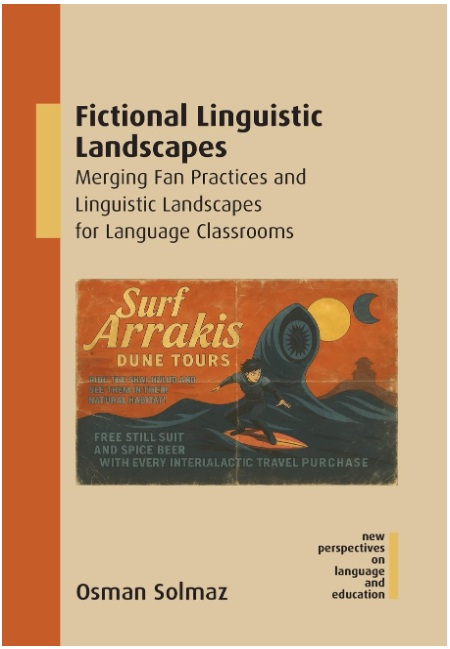
Sun Young Park and Kara Mac Donald
Introduction to Book Review
Fandom propels social interaction and creativity to a heightened level in numerous ways. Whether movies, pop music or beyond, fans not only follow but often adopt or embody the practices of their idols or groups. In this book’s foreword, Durk Gorter situates Osman Solmaz’s book within the broader field of linguistic landscape studies and fandom, highlighting how the work expands the field beyond real-world signage into imagined and fictional spaces. Connecting traditional examination of visible language in public space with fan practices, such as fan fiction, digital media, and popular culture, can make language learning more relevant and engaging for students. The approach fosters multimodal literacy, creativity, and intercultural awareness while also demonstrating how linguistic landscapes can evolve to include new, digitally mediated and imaginative contexts for the language classroom.
Chapter 1: Introduction; Navigating and Experiencing Realities through Fiction
In Chapter One, Solmaz presents the idea that language shapes how we perceive and experience things in both real and imagined worlds. This places linguistic landscapes not only as physical signs in public spaces but also as meaning-making systems within fictional environments. People navigate multiple realities, including those found in media, fandoms, and digital spaces, where language, symbols, and narratives construct identity, power, and place. The chapter lays the foundation for Fictional Linguistic Landscapes (FLL) by showing how engagement with fictional worlds (e.g., sci-fi, fantasy, or popular culture) can mirror and deepen understanding of real-world sociolinguistic dynamics. From there, it frames fiction as a pedagogically rich space where learners can actively engage to interpret, create, and negotiate meaning, bridging imagination and lived experience in language learning.
Chapter 2: A Critical Review of Linguistic Landscapes in Second Language Teaching and Learning
Chapter 2 examines how linguistic landscapes (LL), the visible use of language in public and semiotic spaces, have been integrated into second language (L2) teaching, identifying key trends, strengths, and limitations in existing practice and research. Solmaz highlights that LL-based pedagogy has increasingly been used to promote authentic, place-based learning, helping learners notice real-world language use, develop sociolinguistic awareness, and connect classroom learning to everyday contexts. However, he points out gaps in the literature, such as limited attention to critical literacy, multimodality, and learner agency. He also calls attention to a tendency toward observational activities, rather than generative-production activities through collaboration. Building on these, Solmaz introduces an LL literacies-based pedagogical model in second language (L2) teaching that emphasizes meaning-making across multiple modes, critical engagement with language, and the role of ideology, identity, and power in linguistic landscapes. The chapter establishes the need to expand LL pedagogy toward more dynamic, learner-centered, and critically informed practices. This is the foundation of the book’s focus on fictional and fan-based environments.
Chapter 3: A Comprehensive Exploration of Fan Practices for Language Teaching and Learning
Chapter 3 describes what fan practices are and gives examples. As they are broad, the author shares such examples of fan fiction books, movies and television, fan art (i.e. Bansky), music and remixing, and social media participation. He examines such social fan practices and how they are shaped by digital culture, creating rich, participatory spaces for meaning-making and identity formation. Since the domain is broad, Solmaz categorizes different types of fan activities and highlights how they are inherently multimodal, collaborative, and driven by learner interest, making them powerful tools for language development. He also reviews emerging research showing that fan practices support engagement, creativity, critical literacy, and intercultural competence, while allowing learners to take on more active, agentive roles. Building on this, Solmaz proposes ways to integrate such fan practices into language classrooms through structured pedagogical models, demonstrating how teachers can transform informal, fan-based activities into intentional, curriculum-aligned learning experiences that bridge digital culture and second language education.
Chapter 4: Language Learners Designing Fan(ish) Semiotic Landscapes for Frank Herbert’s Dune Universe
Chapter 4 explores how language learners actively create fan(ish) LLs, using Dune (1965) an example for blending elements of fandom with structured instructional goals. Dune is a classic science fiction novel by Frank Herbert. It takes place in a distant future and follows the main character as he navigates political intrigue, ecological challenges, and cultural conflicts on the desert planet Arrakis. The novel is widely recognized for its complex world-building, exploration of power, religion, and environment and has become one of the most influential works in science fiction. Based on this example, Solmaz shows how students can create multimodal artifacts, such as maps, symbols, signage, and narratives, based on the fictional world, using language to construct meaning, identity, and place within that universe. The sample activities encourage learners to engage in creative social/community-building while applying linguistic, cultural, and semiotic knowledge. This moves students beyond passive analysis to active production using real-word actors and power relations.
Chapter 5: Skinscapes and Fan Artworks as Multimodal Meaning-Making Literacy Practices in Language Classrooms
Chapter 5 focuses on how learners use skinscapes (i.e., visual customization such as digital skins, costumes, or character design) and fan artworks as multimodal tools for language learning. Solmaz explains how these creative practices allow students to combine visual design, symbolism, text, and identity work, turning language learning into an embodied and creative process. By designing skins, characters, and visual representations, learners engage in meaning-making across multiple modes: image, language, and cultural symbolism, rather than relying on text alone. The author argues that these practices foster agency, motivation, and deeper cultural awareness, as students interpret, remix, and personalize fictional worlds. In the end, it demonstrates how fan art and customization can serve as powerful literacy practices that connect imagination, identity, and language learning in authentic and engaging ways.
Chapter 6: Resonating through the Sands of Arrakis: Learners Socializing into Musical Fan Practices
Chapter 6 presents one of the most innovative examples of contemporary language pedagogy. Drawing on the universe of (1965), a soundscape-oriented fan practices model of fictional linguistic landscapes (FLL) tasks learners to reimagine existing songs to resonate with the fictional world of Arrakis. It shifts students’ roles from passive language learners to active users interplaying between language, culture, and creativity within the dynamic and immersive learning environment. The chapter illustrates the four-phase sequence to engage EFL learners in soundscapes-oriented lyrical fan practices within the language classroom. The situated practice activates learners’ personal soundscapes and introduces fandom music culture; the guided exploration presents how music and lyrics tell stories in songs, shaping emotional responses and thematic interpretation to enhance learners’ comprehension; the creation tasks learners to reimage the lyrics of a chosen song within the Duniverse, underscoring both lexical and syntactical modification; and the transformed practice presents learners’ original lyrics and reimaged versions, followed by critical evaluation.
Chapter 7: From Digital Fandom to Language Education Leveraging Fan Practices within Social Mediascapes
This chapter explores the pedagogical potential of the digitally mediated spaces by examining how virtual linguistic landscapes (VLLs) and fan practices on social media can be meaningfully integrated into language classrooms. Grounded in the Fandom Linguistic Landscapes (FLL) in a second language model, the chapter illustrates how learners construct and express identities inspired by Frank Herbert’s Dune (1965), engage in social interactions, develop social media literacies, renegotiate complex multilingual identities, and build a sense of community while utilizing diverse textual and multimodal digital platforms, such as Facebook, Instagram, Twitter and YouTube. The chapter provides its detailed and replicable four-phase sequence as a practical framework for effective implementation. The situated phase establishes foundational comprehension of virtual landscape and fan practices on social media; guided exploration fosters critical analysis and evaluation of sociocultural aspects in the digital linguistic landscape; the creation phase engages learners in designing multilingual character profiles and identities via character-centered accounts; and the transformed practice encourages reflection on how these representations connect to broader real-world values and contexts.
Chapter 8: Leveraging Fictional Linguistic Landscapes in Teacher Education Insights from Lesson Plan Analysis
Chapter 8 explores how the fictional linguistic landscapes (FLLs) pedagogical model can be integrated in the EFL teacher education using a collection of FLL-oriented lesson plans. Based on research on linguistic landscapes and fan practices, the chapter illustrates how the FLLinL2TL model in teacher education can foster intercultural awareness, critical thinking, heightened awareness of identities, and social and cultural perspectives within participatory linguistic environments. The lesson plans developed by 46 student teachers feature how the student teachers select fictional universes, incorporate fan art and fanfiction, and utilize digital design tools (e.g., Canva, PowerPoint, and AI-based platforms), connecting fictional worlds to real-world sociocultural issues and exploring identities within larger power structures and narratives. The chapter provides a detailed account on how to systematically navigate four phases of FLLinL2TL model in teacher education through the four-phase sequence—situated practice, guided exploration, creation, and transformed practice. These range from connecting fan practices and linguistic landscapes to prior knowledge, to analyzing how fictional worlds support authentic language learning, to designing FLL-based lesson plans, and presenting their work to bridge theory and practice. This practice may entail potential challenges, including balancing creativity with language objectives, ensuring cultural sensitivity, managing time and resources, and assessing multimodal outputs. These are discussed to raise awareness of real classroom constraints. This chapter provides teacher educators a valuable, dynamic framework that expands language learners’ acquisition of linguistic and multimodal landscapes, fostering linguistic competence while empowering learners to become critical thinkers and creative problem solvers.
Chapter 9: Conclusion – Key Insights and Implications
Chapter 9 brings together all discussions to show how linguistic landscapes and fan practices in language education create more engaging, participatory, and meaningful learning environments. Solmaz highlights that when learners move from observing language to actively designing and reimagining semiotic worlds, they develop stronger multimodal literacy, critical awareness, and learner agency. The conclusion reinforces the importance of bridging real and fictional contexts, showing that both are valuable sites for language use, identity formation, and cultural interpretation. It offers teachers a way to further adapt instruction to be more innovative though flexible pedagogies that incorporate digital culture, creativity, and student interests.
Conclusion
Despite possible educators’ concerns regarding incorporating fan practices centered around fandom-scapes, such as a) loss of academic rigor; 2) time and resource demands; 3) accessibilities issues for sound-based activities; and d) creativity overshadowing accuracy - the benefits outweigh concerns. The discussed practices not only encourage learners to expand their linguistic capabilities but also expose them to multiple forms of communication and expression through legitimate semiotic resources. They promote transcultural digital literacy, foster critical and creative thinking rather than rote reproduction, and leverage the motivational power of popular culture and fandoms to enhance engagement. As a result, students actively participate in authentic language use that requires vocabulary precision, grammatical control, and pragmatic awareness.
Michelle Skowbo
Fictional Linguistic Landscapes: Merging Fan Practices and Linguistic Landscapes for Language Classrooms by Osman Solmaz
Sun Young Park and Kara Mac Donald
Introduction to Book Review
Fandom propels social interaction and creativity to a heightened level in numerous ways. Whether movies, pop music or beyond, fans not only follow but often adopt or embody the practices of their idols or groups. In this book’s foreword, Durk Gorter situates Osman Solmaz’s book within the broader field of linguistic landscape studies and fandom, highlighting how the work expands the field beyond real-world signage into imagined and fictional spaces. Connecting traditional examination of visible language in public space with fan practices, such as fan fiction, digital media, and popular culture, can make language learning more relevant and engaging for students. The approach fosters multimodal literacy, creativity, and intercultural awareness while also demonstrating how linguistic landscapes can evolve to include new, digitally mediated and imaginative contexts for the language classroom.
Chapter 1: Introduction; Navigating and Experiencing Realities through Fiction
In Chapter One, Solmaz presents the idea that language shapes how we perceive and experience things in both real and imagined worlds. This places linguistic landscapes not only as physical signs in public spaces but also as meaning-making systems within fictional environments. People navigate multiple realities, including those found in media, fandoms, and digital spaces, where language, symbols, and narratives construct identity, power, and place. The chapter lays the foundation for Fictional Linguistic Landscapes (FLL) by showing how engagement with fictional worlds (e.g., sci-fi, fantasy, or popular culture) can mirror and deepen understanding of real-world sociolinguistic dynamics. From there, it frames fiction as a pedagogically rich space where learners can actively engage to interpret, create, and negotiate meaning, bridging imagination and lived experience in language learning.
Chapter 2: A Critical Review of Linguistic Landscapes in Second Language Teaching and Learning
Chapter 2 examines how linguistic landscapes (LL), the visible use of language in public and semiotic spaces, have been integrated into second language (L2) teaching, identifying key trends, strengths, and limitations in existing practice and research. Solmaz highlights that LL-based pedagogy has increasingly been used to promote authentic, place-based learning, helping learners notice real-world language use, develop sociolinguistic awareness, and connect classroom learning to everyday contexts. However, he points out gaps in the literature, such as limited attention to critical literacy, multimodality, and learner agency. He also calls attention to a tendency toward observational activities, rather than generative-production activities through collaboration. Building on these, Solmaz introduces an LL literacies-based pedagogical model in second language (L2) teaching that emphasizes meaning-making across multiple modes, critical engagement with language, and the role of ideology, identity, and power in linguistic landscapes. The chapter establishes the need to expand LL pedagogy toward more dynamic, learner-centered, and critically informed practices. This is the foundation of the book’s focus on fictional and fan-based environments.
Chapter 3: A Comprehensive Exploration of Fan Practices for Language Teaching and Learning
Chapter 3 describes what fan practices are and gives examples. As they are broad, the author shares such examples of fan fiction books, movies and television, fan art (i.e. Bansky), music and remixing, and social media participation. He examines such social fan practices and how they are shaped by digital culture, creating rich, participatory spaces for meaning-making and identity formation. Since the domain is broad, Solmaz categorizes different types of fan activities and highlights how they are inherently multimodal, collaborative, and driven by learner interest, making them powerful tools for language development. He also reviews emerging research showing that fan practices support engagement, creativity, critical literacy, and intercultural competence, while allowing learners to take on more active, agentive roles. Building on this, Solmaz proposes ways to integrate such fan practices into language classrooms through structured pedagogical models, demonstrating how teachers can transform informal, fan-based activities into intentional, curriculum-aligned learning experiences that bridge digital culture and second language education.
Chapter 4: Language Learners Designing Fan(ish) Semiotic Landscapes for Frank Herbert’s Dune Universe
Chapter 4 explores how language learners actively create fan(ish) LLs, using Dune (1965) an example for blending elements of fandom with structured instructional goals. Dune is a classic science fiction novel by Frank Herbert. It takes place in a distant future and follows the main character as he navigates political intrigue, ecological challenges, and cultural conflicts on the desert planet Arrakis. The novel is widely recognized for its complex world-building, exploration of power, religion, and environment and has become one of the most influential works in science fiction. Based on this example, Solmaz shows how students can create multimodal artifacts, such as maps, symbols, signage, and narratives, based on the fictional world, using language to construct meaning, identity, and place within that universe. The sample activities encourage learners to engage in creative social/community-building while applying linguistic, cultural, and semiotic knowledge. This moves students beyond passive analysis to active production using real-word actors and power relations.
Chapter 5: Skinscapes and Fan Artworks as Multimodal Meaning-Making Literacy Practices in Language Classrooms
Chapter 5 focuses on how learners use skinscapes (i.e., visual customization such as digital skins, costumes, or character design) and fan artworks as multimodal tools for language learning. Solmaz explains how these creative practices allow students to combine visual design, symbolism, text, and identity work, turning language learning into an embodied and creative process. By designing skins, characters, and visual representations, learners engage in meaning-making across multiple modes: image, language, and cultural symbolism, rather than relying on text alone. The author argues that these practices foster agency, motivation, and deeper cultural awareness, as students interpret, remix, and personalize fictional worlds. In the end, it demonstrates how fan art and customization can serve as powerful literacy practices that connect imagination, identity, and language learning in authentic and engaging ways.
Chapter 6: Resonating through the Sands of Arrakis: Learners Socializing into Musical Fan Practices
Chapter 6 presents one of the most innovative examples of contemporary language pedagogy. Drawing on the universe of (1965), a soundscape-oriented fan practices model of fictional linguistic landscapes (FLL) tasks learners to reimagine existing songs to resonate with the fictional world of Arrakis. It shifts students’ roles from passive language learners to active users interplaying between language, culture, and creativity within the dynamic and immersive learning environment. The chapter illustrates the four-phase sequence to engage EFL learners in soundscapes-oriented lyrical fan practices within the language classroom. The situated practice activates learners’ personal soundscapes and introduces fandom music culture; the guided exploration presents how music and lyrics tell stories in songs, shaping emotional responses and thematic interpretation to enhance learners’ comprehension; the creation tasks learners to reimage the lyrics of a chosen song within the Duniverse, underscoring both lexical and syntactical modification; and the transformed practice presents learners’ original lyrics and reimaged versions, followed by critical evaluation.
Chapter 7: From Digital Fandom to Language Education Leveraging Fan Practices within Social Mediascapes
This chapter explores the pedagogical potential of the digitally mediated spaces by examining how virtual linguistic landscapes (VLLs) and fan practices on social media can be meaningfully integrated into language classrooms. Grounded in the Fandom Linguistic Landscapes (FLL) in a second language model, the chapter illustrates how learners construct and express identities inspired by Frank Herbert’s Dune (1965), engage in social interactions, develop social media literacies, renegotiate complex multilingual identities, and build a sense of community while utilizing diverse textual and multimodal digital platforms, such as Facebook, Instagram, Twitter and YouTube. The chapter provides its detailed and replicable four-phase sequence as a practical framework for effective implementation. The situated phase establishes foundational comprehension of virtual landscape and fan practices on social media; guided exploration fosters critical analysis and evaluation of sociocultural aspects in the digital linguistic landscape; the creation phase engages learners in designing multilingual character profiles and identities via character-centered accounts; and the transformed practice encourages reflection on how these representations connect to broader real-world values and contexts.
Chapter 8: Leveraging Fictional Linguistic Landscapes in Teacher Education Insights from Lesson Plan Analysis
Chapter 8 explores how the fictional linguistic landscapes (FLLs) pedagogical model can be integrated in the EFL teacher education using a collection of FLL-oriented lesson plans. Based on research on linguistic landscapes and fan practices, the chapter illustrates how the FLLinL2TL model in teacher education can foster intercultural awareness, critical thinking, heightened awareness of identities, and social and cultural perspectives within participatory linguistic environments. The lesson plans developed by 46 student teachers feature how the student teachers select fictional universes, incorporate fan art and fanfiction, and utilize digital design tools (e.g., Canva, PowerPoint, and AI-based platforms), connecting fictional worlds to real-world sociocultural issues and exploring identities within larger power structures and narratives. The chapter provides a detailed account on how to systematically navigate four phases of FLLinL2TL model in teacher education through the four-phase sequence—situated practice, guided exploration, creation, and transformed practice. These range from connecting fan practices and linguistic landscapes to prior knowledge, to analyzing how fictional worlds support authentic language learning, to designing FLL-based lesson plans, and presenting their work to bridge theory and practice. This practice may entail potential challenges, including balancing creativity with language objectives, ensuring cultural sensitivity, managing time and resources, and assessing multimodal outputs. These are discussed to raise awareness of real classroom constraints. This chapter provides teacher educators a valuable, dynamic framework that expands language learners’ acquisition of linguistic and multimodal landscapes, fostering linguistic competence while empowering learners to become critical thinkers and creative problem solvers.
Chapter 9: Conclusion – Key Insights and Implications
Chapter 9 brings together all discussions to show how linguistic landscapes and fan practices in language education create more engaging, participatory, and meaningful learning environments. Solmaz highlights that when learners move from observing language to actively designing and reimagining semiotic worlds, they develop stronger multimodal literacy, critical awareness, and learner agency. The conclusion reinforces the importance of bridging real and fictional contexts, showing that both are valuable sites for language use, identity formation, and cultural interpretation. It offers teachers a way to further adapt instruction to be more innovative though flexible pedagogies that incorporate digital culture, creativity, and student interests.
Conclusion
Despite possible educators’ concerns regarding incorporating fan practices centered around fandom-scapes, such as a) loss of academic rigor; 2) time and resource demands; 3) accessibilities issues for sound-based activities; and d) creativity overshadowing accuracy - the benefits outweigh concerns. The discussed practices not only encourage learners to expand their linguistic capabilities but also expose them to multiple forms of communication and expression through legitimate semiotic resources. They promote transcultural digital literacy, foster critical and creative thinking rather than rote reproduction, and leverage the motivational power of popular culture and fandoms to enhance engagement. As a result, students actively participate in authentic language use that requires vocabulary precision, grammatical control, and pragmatic awareness.