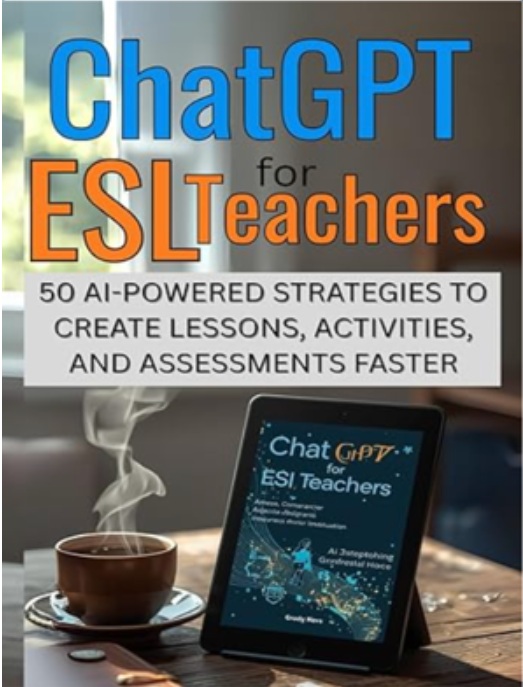
CATESOL Book Review: ChatGPT for ESL Teachers: 50 AI-Powered Strategies to Create Lessons, Activities, and Assessments Faster by Anna Foster
01/28/2026
Michelle Skowbo
Ragaa Shenouda, EdD
Introductory Overview
ChatGPT for ESL Teachers: 50 AI-Powered Strategies to Create Lessons, Activities, and Assessments Faster by Anna Foster is a practical and teacher-friendly guide designed to help ESL educators use artificial intelligence effectively and confidently in their classrooms. The book presents 50 easy-to-implement strategies that demonstrate how ChatGPT can support lesson planning, classroom activities, and assessment design while saving time and increasing student engagement. Grounded in real classroom needs, the book empowers teachers to integrate AI as a supportive instructional tool without compromising sound pedagogy or professional judgment.
Introduction
In ChatGPT for ESL Teachers: 50 AI-Powered Strategies to Create Lessons, Activities, and Assessments Faster (2025), Anna Foster acknowledges the increasing demands placed on ESL educators and introduces ChatGPT as a support tool—not a replacement—for teachers. The book offers 50 practical, AI-powered strategies to streamline lesson planning, activity creation, assessment design, differentiation, and feedback. Through concrete examples and reflective questions in each chapter, Foster positions the book as a hands-on toolkit that helps reduce teacher burnout while allowing educators to refocus on purposeful instruction, meaningful relationships, and student engagement.
Chapter 1: Teaching in the Age of AI – A New Beginning
In Chapter 1, Anna Foster emphasizes that although artificial intelligence is transforming education, it cannot replace the essential human qualities that ESL teachers bring to the classroom. These include empathy, adaptability, creativity, encouragement, and the ability to build meaningful relationships with students. Foster argues that language learning is inherently social and emotional, requiring trust, responsiveness, and ongoing support—elements AI cannot replicate. Teaching, she explains, is not defined by perfect lesson plans or polished presentations, but by human connection, intuition, and the ability to respond to students’ needs in real time. AI should therefore be viewed as a supportive tool that handles routine tasks, provides practice opportunities, and generates feedback, freeing teachers to focus on guiding, inspiring, and motivating learners. The chapter concludes that effective ESL instruction emerges from a balanced blend of AI’s efficiency and the creativity and empathy of human teachers.
Chapter 2: Getting Comfortable with ChatGPT
Chapter 2 reassures readers that accessing and using ChatGPT is easier than many teachers expect—often requiring only a few clicks or the blink of a cursor. The chapter walks users through signing up, logging in, and navigating the interface on both web browsers and mobile apps, highlighting key features such as the chat window, settings, and conversation history. It also introduces foundational skills, including editing responses, using instructions effectively, and starting productive conversations. These initial steps matter because they establish a strong foundation for confident and efficient use, helping teachers avoid frustration and maximize the tool’s potential. Overall, the chapter presents ChatGPT as intuitive, accessible, and empowering for educators at all levels of technological experience.
Chapter 3: Lesson Planning Made Easy with AI
In this chapter, Foster explains that lesson planning remains essential for effective ESL instruction, even when AI tools are involved, because teachers understand their students’ goals, needs, and classroom realities in ways technology cannot. ChatGPT is not intended to replace teacher expertise but to support and simplify the planning process while teachers remain fully in control. AI can generate lesson ideas, outlines, activities, and variations, allowing teachers to select, adapt, and refine what works best for their learners. By handling repetitive planning tasks, AI saves time and mental energy, enabling teachers to focus more on instruction, interaction, and feedback. Foster also addresses unit planning, which many teachers find challenging due to the time and consistency it requires. She explains how AI can quickly generate clear, coherent unit frameworks organized around themes, skills, and objectives, making long-term planning more manageable. Additionally, AI can help refresh or redesign existing units by offering alternative activities and extensions—an especially valuable feature in ESL classrooms where students benefit from varied and repeated language practice. Overall, the chapter encourages a mindset shift, positioning AI as a helpful assistant that enhances efficiency, creativity, and consistency while teachers remain the instructional experts guiding learning.
Chapter 4: Speaking Activities That Spark Real Conversations
Chapter 4 highlights how AI can support ESL teachers by generating engaging, level-appropriate speaking activities that promote authentic communication while reducing planning time. Foster reinforces that AI does not replace teachers but serves as a planning assistant that sparks ideas and streamlines preparation. This allows teachers to focus on facilitating interaction and supporting student learning. The chapter explores three primary types of AI-supported speaking activities: role plays, debates and discussions, and fluency-building speaking games. AI helps teachers quickly create realistic role-play scenarios that reflect real-world language use and encourage participation, even among quieter students. It also supports the creation of culturally sensitive debate topics that foster critical thinking and meaningful expression. Additionally, AI-generated speaking games provide low-pressure opportunities for spontaneous speech, increased talk time, and fluency development. Overall, the chapter presents AI as a valuable instructional partner that enhances creativity and authentic communication while keeping teachers at the center of classroom learning.
Chapter 5: Writing Prompts and Essay Practice Made Easy
In this chapter, Foster explains how AI can simplify and strengthen writing instruction by helping teachers generate clear, engaging, and level-appropriate writing prompts. Writing instruction is often time-consuming, requiring thoughtful prompt design, scaffolding, and individualized feedback—particularly in classes with diverse proficiency levels. AI supports teachers by quickly generating adaptable banks of writing prompts aligned with different interests and learning objectives, while teachers remain responsible for modeling, guiding, and assessing student writing. Foster highlights two main ways AI enhances writing practice. For low-pressure writing, AI can generate reflective journal prompts that encourage personal expression and build writing fluency, such as “Describe one moment from today that made you smile.” These quick writes help reduce anxiety and build confidence. At higher proficiency levels, AI supports structured essay practice by generating prompts focused on organization, argumentation, and critical thinking, such as “Is technology helping or hurting human relationships?” AI can also support scaffolding by generating outlines, thesis statements, and supporting ideas, helping students view writing as a structured and manageable process. As a result, teachers can devote more time to providing meaningful feedback and supporting students’ long-term writing development.
Chapter 6: Grammar and Vocabulary Without the Boredom
In Chapter 6, Foster emphasizes that effective grammar and vocabulary instruction requires moving beyond isolated written exercises and toward meaningful language use. Students learn grammar more effectively when they apply structures in communicative contexts rather than memorizing rules or completing worksheets. By focusing on purposeful language use, teachers help students internalize grammar and vocabulary naturally while maintaining motivation and engagement. Foster highlights interactive activities such as pair work, storytelling challenges, sentence races, and creative dialogues that require real-time language use and collaboration. Vocabulary games further reinforce learning by encouraging repetition, interaction, and confidence. She notes that teachers often struggle to create fresh practice activities, which can lead to repetitive or dull instruction. AI addresses this challenge by generating varied and creative examples, such as mini-stories for past-tense practice or dialogues built around conditional structures. Through these applications, AI helps students view grammar and vocabulary as practical tools for communication rather than abstract rules to memorize.
Chapter 7: Quick Quizzes and Assessments in Minutes
In this chapter, Foster reframes assessment as a tool for guiding learning rather than catching students off guard. Effective quizzes help teachers monitor progress, identify gaps, and provide students with clear feedback on their strengths and areas for improvement. Foster emphasizes that assessment should be formative and supportive, not high-stakes. However, creating frequent, meaningful assessments can be time-consuming, often limiting their use. AI helps address this challenge by generating customized quizzes in minutes, including multiple-choice, true-or-false, fill-in-the-blank, and short-answer questions aligned with specific language targets. Beyond quizzes, AI supports the creation of clear rubrics for writing, speaking, and performance-based assessments. Foster highlights that rubrics promote transparency, clarify expectations, and save time while providing more meaningful feedback. AI also supports quick formative checks such as exit tickets, comprehension questions, and reflections, enabling teachers to gather real-time insights into student understanding. Together, these tools reinforce assessment as an ongoing process that supports learning and instructional decision-making.
Chapter 8: Personalizing Learning for Every Student
Chapter 8 addresses one of the most persistent challenges in ESL classrooms: meeting the needs of students with varying proficiency levels. Foster explains that differentiation is essential, as students learn language at different rates. Without it, beginning learners struggle, advanced students disengage, and teachers feel overwhelmed. This chapter demonstrates how AI can support personalized instruction by quickly adapting activities, texts, and assessments to different proficiency levels. By providing core content, teachers can use AI to adjust language complexity, task demands, and scaffolding without lowering expectations. For struggling learners, AI can generate simplified texts, sentence starters, and step-by-step guides that support meaningful participation. At the same time, AI can enrich tasks for advanced learners by adding depth, expanding vocabulary, and increasing cognitive demands. Foster emphasizes that AI-driven differentiation allows teachers to meet diverse needs efficiently while maintaining high expectations and inclusive classroom practices.
Chapter 9: Time -Saving Hacks for Grading and Feedback
Chapter 9 focuses on one of the most demanding aspects of ESL teaching: providing meaningful, constructive feedback while managing limited time and emotional energy. Foster emphasizes that feedback is a critical instructional tool that guides students toward success by helping them recognize their strengths, understand areas for improvement, and take clear next steps in their learning. However, delivering clear, balanced, and personalized feedback is particularly challenging for ESL teachers due to time pressure, repetitive error patterns, heavy grading loads, and emotional fatigue. As a result, feedback can become brief or generic, reducing its impact on student growth. To address this challenge, Foster demonstrates how AI can support teachers in writing high-quality feedback more efficiently by generating comments that are faster, clearer, and more constructive. She provides concrete examples of AI-assisted feedback for essay writing, speaking activities, and vocabulary practice, illustrating how well-crafted comments guide students toward improvement while maintaining an encouraging tone. By reducing the need for teachers to repeat themselves, AI allows educators to spend less time drafting repetitive comments and more time motivating, encouraging, and connecting with their students. Importantly, Foster stresses that AI enhances rather than replaces the teacher’s professional judgment, positioning it as a practical tool to improve feedback quality, reduce burnout, and support student success.
Chapter 10: From Overwhelm to Empowerment: The Teacher’s AI Toolkit
In Chapter 10, Foster brings the book to a close by offering a comprehensive recap of the AI-powered strategies presented throughout the text, reframing them as a practical toolkit to move teachers from overwhelm to empowerment. She revisits each stage of AI integration—from logging in and understanding basic prompts to more advanced applications such as lesson planning, speaking activities, writing practice, grammar drills, quizzes, personalization, and feedback. Foster emphasizes that each strategy is intentionally designed to reduce ESL teachers' workload while increasing instructional impact on students. Rather than presenting AI as a complex or intimidating tool, she breaks down each strategy with clear explanations and practical details, demonstrating how it can be integrated into daily teaching routines in manageable, purposeful ways. Throughout the chapter, Foster reinforces the idea that AI is not meant to replace teacher expertise but to support it, allowing educators to spend less time on repetitive tasks and more time focusing on student engagement, differentiation, and meaningful language use. Overall, Chapter 10 presents AI as an effective instructional partner that enables ESL teachers to teach more effectively, with greater responsibility and confidence.
Conclusion
In conclusion, these ten chapters present a clear and compelling vision for ESL teaching in the age of AI—one grounded in balance, practicality, and teacher empowerment. Foster consistently positions AI not as a replacement for educators, but as a supportive partner that reduces workload, enhances instructional quality, and creates more space for what matters most: human connection, student motivation, and meaningful language use. By guiding teachers from basic access to advanced classroom applications, the book demonstrates how AI can make teaching more efficient, personalized, and manageable without sacrificing empathy or professional judgment. Ultimately, ChatGPT for ESL Teachers reframes AI as a tool that helps teachers teach smarter, not harder, while strengthening student learning and long-term success.
Michelle Skowbo
ChatGPT For ESL Teachers: 50 AI-Powered Strategies to Create Lessons, Activities, and Assessments Faster by Anna Foster
Ragaa Shenouda, EdD
Introductory Overview
ChatGPT for ESL Teachers: 50 AI-Powered Strategies to Create Lessons, Activities, and Assessments Faster by Anna Foster is a practical and teacher-friendly guide designed to help ESL educators use artificial intelligence effectively and confidently in their classrooms. The book presents 50 easy-to-implement strategies that demonstrate how ChatGPT can support lesson planning, classroom activities, and assessment design while saving time and increasing student engagement. Grounded in real classroom needs, the book empowers teachers to integrate AI as a supportive instructional tool without compromising sound pedagogy or professional judgment.
Introduction
In ChatGPT for ESL Teachers: 50 AI-Powered Strategies to Create Lessons, Activities, and Assessments Faster (2025), Anna Foster acknowledges the increasing demands placed on ESL educators and introduces ChatGPT as a support tool—not a replacement—for teachers. The book offers 50 practical, AI-powered strategies to streamline lesson planning, activity creation, assessment design, differentiation, and feedback. Through concrete examples and reflective questions in each chapter, Foster positions the book as a hands-on toolkit that helps reduce teacher burnout while allowing educators to refocus on purposeful instruction, meaningful relationships, and student engagement.
Chapter 1: Teaching in the Age of AI – A New Beginning
In Chapter 1, Anna Foster emphasizes that although artificial intelligence is transforming education, it cannot replace the essential human qualities that ESL teachers bring to the classroom. These include empathy, adaptability, creativity, encouragement, and the ability to build meaningful relationships with students. Foster argues that language learning is inherently social and emotional, requiring trust, responsiveness, and ongoing support—elements AI cannot replicate. Teaching, she explains, is not defined by perfect lesson plans or polished presentations, but by human connection, intuition, and the ability to respond to students’ needs in real time. AI should therefore be viewed as a supportive tool that handles routine tasks, provides practice opportunities, and generates feedback, freeing teachers to focus on guiding, inspiring, and motivating learners. The chapter concludes that effective ESL instruction emerges from a balanced blend of AI’s efficiency and the creativity and empathy of human teachers.
Chapter 2: Getting Comfortable with ChatGPT
Chapter 2 reassures readers that accessing and using ChatGPT is easier than many teachers expect—often requiring only a few clicks or the blink of a cursor. The chapter walks users through signing up, logging in, and navigating the interface on both web browsers and mobile apps, highlighting key features such as the chat window, settings, and conversation history. It also introduces foundational skills, including editing responses, using instructions effectively, and starting productive conversations. These initial steps matter because they establish a strong foundation for confident and efficient use, helping teachers avoid frustration and maximize the tool’s potential. Overall, the chapter presents ChatGPT as intuitive, accessible, and empowering for educators at all levels of technological experience.
Chapter 3: Lesson Planning Made Easy with AI
In this chapter, Foster explains that lesson planning remains essential for effective ESL instruction, even when AI tools are involved, because teachers understand their students’ goals, needs, and classroom realities in ways technology cannot. ChatGPT is not intended to replace teacher expertise but to support and simplify the planning process while teachers remain fully in control. AI can generate lesson ideas, outlines, activities, and variations, allowing teachers to select, adapt, and refine what works best for their learners. By handling repetitive planning tasks, AI saves time and mental energy, enabling teachers to focus more on instruction, interaction, and feedback. Foster also addresses unit planning, which many teachers find challenging due to the time and consistency it requires. She explains how AI can quickly generate clear, coherent unit frameworks organized around themes, skills, and objectives, making long-term planning more manageable. Additionally, AI can help refresh or redesign existing units by offering alternative activities and extensions—an especially valuable feature in ESL classrooms where students benefit from varied and repeated language practice. Overall, the chapter encourages a mindset shift, positioning AI as a helpful assistant that enhances efficiency, creativity, and consistency while teachers remain the instructional experts guiding learning.
Chapter 4: Speaking Activities That Spark Real Conversations
Chapter 4 highlights how AI can support ESL teachers by generating engaging, level-appropriate speaking activities that promote authentic communication while reducing planning time. Foster reinforces that AI does not replace teachers but serves as a planning assistant that sparks ideas and streamlines preparation. This allows teachers to focus on facilitating interaction and supporting student learning. The chapter explores three primary types of AI-supported speaking activities: role plays, debates and discussions, and fluency-building speaking games. AI helps teachers quickly create realistic role-play scenarios that reflect real-world language use and encourage participation, even among quieter students. It also supports the creation of culturally sensitive debate topics that foster critical thinking and meaningful expression. Additionally, AI-generated speaking games provide low-pressure opportunities for spontaneous speech, increased talk time, and fluency development. Overall, the chapter presents AI as a valuable instructional partner that enhances creativity and authentic communication while keeping teachers at the center of classroom learning.
Chapter 5: Writing Prompts and Essay Practice Made Easy
In this chapter, Foster explains how AI can simplify and strengthen writing instruction by helping teachers generate clear, engaging, and level-appropriate writing prompts. Writing instruction is often time-consuming, requiring thoughtful prompt design, scaffolding, and individualized feedback—particularly in classes with diverse proficiency levels. AI supports teachers by quickly generating adaptable banks of writing prompts aligned with different interests and learning objectives, while teachers remain responsible for modeling, guiding, and assessing student writing. Foster highlights two main ways AI enhances writing practice. For low-pressure writing, AI can generate reflective journal prompts that encourage personal expression and build writing fluency, such as “Describe one moment from today that made you smile.” These quick writes help reduce anxiety and build confidence. At higher proficiency levels, AI supports structured essay practice by generating prompts focused on organization, argumentation, and critical thinking, such as “Is technology helping or hurting human relationships?” AI can also support scaffolding by generating outlines, thesis statements, and supporting ideas, helping students view writing as a structured and manageable process. As a result, teachers can devote more time to providing meaningful feedback and supporting students’ long-term writing development.
Chapter 6: Grammar and Vocabulary Without the Boredom
In Chapter 6, Foster emphasizes that effective grammar and vocabulary instruction requires moving beyond isolated written exercises and toward meaningful language use. Students learn grammar more effectively when they apply structures in communicative contexts rather than memorizing rules or completing worksheets. By focusing on purposeful language use, teachers help students internalize grammar and vocabulary naturally while maintaining motivation and engagement. Foster highlights interactive activities such as pair work, storytelling challenges, sentence races, and creative dialogues that require real-time language use and collaboration. Vocabulary games further reinforce learning by encouraging repetition, interaction, and confidence. She notes that teachers often struggle to create fresh practice activities, which can lead to repetitive or dull instruction. AI addresses this challenge by generating varied and creative examples, such as mini-stories for past-tense practice or dialogues built around conditional structures. Through these applications, AI helps students view grammar and vocabulary as practical tools for communication rather than abstract rules to memorize.
Chapter 7: Quick Quizzes and Assessments in Minutes
In this chapter, Foster reframes assessment as a tool for guiding learning rather than catching students off guard. Effective quizzes help teachers monitor progress, identify gaps, and provide students with clear feedback on their strengths and areas for improvement. Foster emphasizes that assessment should be formative and supportive, not high-stakes. However, creating frequent, meaningful assessments can be time-consuming, often limiting their use. AI helps address this challenge by generating customized quizzes in minutes, including multiple-choice, true-or-false, fill-in-the-blank, and short-answer questions aligned with specific language targets. Beyond quizzes, AI supports the creation of clear rubrics for writing, speaking, and performance-based assessments. Foster highlights that rubrics promote transparency, clarify expectations, and save time while providing more meaningful feedback. AI also supports quick formative checks such as exit tickets, comprehension questions, and reflections, enabling teachers to gather real-time insights into student understanding. Together, these tools reinforce assessment as an ongoing process that supports learning and instructional decision-making.
Chapter 8: Personalizing Learning for Every Student
Chapter 8 addresses one of the most persistent challenges in ESL classrooms: meeting the needs of students with varying proficiency levels. Foster explains that differentiation is essential, as students learn language at different rates. Without it, beginning learners struggle, advanced students disengage, and teachers feel overwhelmed. This chapter demonstrates how AI can support personalized instruction by quickly adapting activities, texts, and assessments to different proficiency levels. By providing core content, teachers can use AI to adjust language complexity, task demands, and scaffolding without lowering expectations. For struggling learners, AI can generate simplified texts, sentence starters, and step-by-step guides that support meaningful participation. At the same time, AI can enrich tasks for advanced learners by adding depth, expanding vocabulary, and increasing cognitive demands. Foster emphasizes that AI-driven differentiation allows teachers to meet diverse needs efficiently while maintaining high expectations and inclusive classroom practices.
Chapter 9: Time -Saving Hacks for Grading and Feedback
Chapter 9 focuses on one of the most demanding aspects of ESL teaching: providing meaningful, constructive feedback while managing limited time and emotional energy. Foster emphasizes that feedback is a critical instructional tool that guides students toward success by helping them recognize their strengths, understand areas for improvement, and take clear next steps in their learning. However, delivering clear, balanced, and personalized feedback is particularly challenging for ESL teachers due to time pressure, repetitive error patterns, heavy grading loads, and emotional fatigue. As a result, feedback can become brief or generic, reducing its impact on student growth. To address this challenge, Foster demonstrates how AI can support teachers in writing high-quality feedback more efficiently by generating comments that are faster, clearer, and more constructive. She provides concrete examples of AI-assisted feedback for essay writing, speaking activities, and vocabulary practice, illustrating how well-crafted comments guide students toward improvement while maintaining an encouraging tone. By reducing the need for teachers to repeat themselves, AI allows educators to spend less time drafting repetitive comments and more time motivating, encouraging, and connecting with their students. Importantly, Foster stresses that AI enhances rather than replaces the teacher’s professional judgment, positioning it as a practical tool to improve feedback quality, reduce burnout, and support student success.
Chapter 10: From Overwhelm to Empowerment: The Teacher’s AI Toolkit
In Chapter 10, Foster brings the book to a close by offering a comprehensive recap of the AI-powered strategies presented throughout the text, reframing them as a practical toolkit to move teachers from overwhelm to empowerment. She revisits each stage of AI integration—from logging in and understanding basic prompts to more advanced applications such as lesson planning, speaking activities, writing practice, grammar drills, quizzes, personalization, and feedback. Foster emphasizes that each strategy is intentionally designed to reduce ESL teachers' workload while increasing instructional impact on students. Rather than presenting AI as a complex or intimidating tool, she breaks down each strategy with clear explanations and practical details, demonstrating how it can be integrated into daily teaching routines in manageable, purposeful ways. Throughout the chapter, Foster reinforces the idea that AI is not meant to replace teacher expertise but to support it, allowing educators to spend less time on repetitive tasks and more time focusing on student engagement, differentiation, and meaningful language use. Overall, Chapter 10 presents AI as an effective instructional partner that enables ESL teachers to teach more effectively, with greater responsibility and confidence.
Conclusion
In conclusion, these ten chapters present a clear and compelling vision for ESL teaching in the age of AI—one grounded in balance, practicality, and teacher empowerment. Foster consistently positions AI not as a replacement for educators, but as a supportive partner that reduces workload, enhances instructional quality, and creates more space for what matters most: human connection, student motivation, and meaningful language use. By guiding teachers from basic access to advanced classroom applications, the book demonstrates how AI can make teaching more efficient, personalized, and manageable without sacrificing empathy or professional judgment. Ultimately, ChatGPT for ESL Teachers reframes AI as a tool that helps teachers teach smarter, not harder, while strengthening student learning and long-term success.