CATESOL Book Review: Algospeak: How Social Media Is Transforming the Future of Language by Adam Aleksic
01/02/2026
Michelle Skowbo
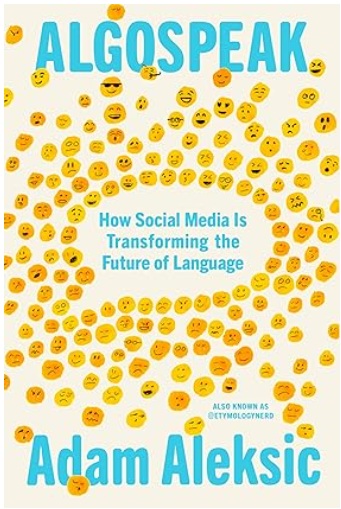
By Federico Pomarici and Kara Mac Donald
Introduction: Why Your Kids Are Saying “Unalive”
The first paragraph pulls in the reader who is not a Millennial (i.e., Gen X or Boomer), or even a Gen Z, with an account of a tribute to the music band, Nirvana, at a Seattle museum with a tribute to the death of the lead singer and guitarist, Kurt Cobain. The account presents signage using "unalive." From this anecdote, Aleksic explains that words like “unalive” have emerged not because young people are trying to be vague or humorous, but because social media algorithms actively shape how we all speak. Online platforms flag, hide, suppress or demonetize content and generate euphemisms that avoid detection. These terms are created by users to adapt to flagged or blocked content. Once these substitutes circulate widely, they become normalized within online communities—sometimes even migrating into offline speech. The intention is to inhibit terms and discussion of violence, self-harm, and other topics among youth, etc. The lexical and phrasal workarounds migrate from online spaces into everyday speech. “Unalive” is an example of how algorithmic moderation influences language change.
Chapter 1 How to Play Linguistic Whac-A-Mole
The chapter introduces the concept of algospeak, which is a kind of coded or evasive language that people use online to circumvent the moderation systems (automated filters, algorithmic detection) of social-media platforms. The author shows how this isn’t just about avoiding censorship, but also about visibility and virality, since platforms treat language as metadata. This suggests that every word conveys signals to the algorithm. So, users adjust how they speak in order to maximize reach, avoid suppression/censorship, or express sensitive topics without being penalized. To note is that what begins online often leaks into offline speech (i.e., schools, everyday conversations), so a word intended to evade an algorithm can become part of normal vocabulary especially among younger people. The author also addresses that this practice is not just a fad of slang, but a sign of how platforms and algorithms are reshaping language norms, how communities adapt, and how invisibly the rules of online spaces can affect everyday offline speech
Chapter 2 Sticking Out Your Gyat for the Rizzler
The beginning of chapter two brings the reader back to how and why language change occurred historically with a look at Middle English and subsequent influences on language change (i.e., the role of government, newspapers, videos, internet). The author explains why language change was slow in prior contexts and how technology over time has influenced the rapid spread of language usage. Aleksic uses phrases like “gyat,” “rizz,” and “rizzler” to describe how slang terms are quickly adopted and shaped by social media platforms, especially TikTok. These slang terms are less about precise definitions and more about performance, how language is used to participate, remix, and be visible in digital spaces governed by algorithms.
Chapter 3 No Because What Happened to Your Attention?
Aleksic has given personal accounts in previous chapters, but he begins this chapter interestingly by sharing that he didn’t think he would be a content creator in high school and why Reddit was attractive to him: the accessibility of the posting algorithm to influence ranking. He walks the reader through what he learned and how it works. He particularly explores how short-form video and algorithm-driven feeds are reshaping attention, thinking, and communication. As an example, he explains youth’s use of fragmented phrases like “no because—” reflects not inaccuracy, but a shift toward conversational styles shaped by interruption, rapid context-switching, and unfinished thoughts common online. Online platforms and the algorithms reward content that is quick, emotionally engaging, and easy to remix, which trains users to think and speak in bursts rather than sustained narratives.
Chapter 4 Why Everybody Sounds the Same Online
Opening another chapter with a personal/online example, Aleksic shares an account of an Indian or Indian-diaspora creator, Sara Deshmukh, who received online criticism and commentary because her spoken English accent did not match what some viewers expected an “Indian accent” to sound like. Her authenticity, cultural identity, etc. was questioned. With this as the staging, the author describes that the parties in the example are not wrong. Online platforms encourage linguistic sameness by rewarding familiar speech patterns, known as viral phrasing, and recognizable emotional tones. Algorithms prioritize content that resembles what has already succeeded, leading users to imitate popular ways of speaking to gain visibility. He argues this convergence is not a failure of creativity but a rational adaptation to algorithmic systems that shape how people communicate, perform identity, and are heard in digital spaces.
Chapter 5 “The Algorithm Really Knows Me”
With a grounding of the expansive power of the internet, its algorithms and impact of viral trends, Aleksic provides examples of how sub-group interests and language are developed and sustained on distinct/parallel platforms. Although platforms predict and shape user behavior, making them feel “seen”/understood, Aleksic argues algorithms group users into categories and feed them content that reinforces existing preferences. Over time, this feedback loop narrows exposure, influences self-perception, and can make people mistake algorithmic alignment for personal identity. Thus, while algorithms may feel personalized, they ultimately optimize engagement rather than well-being, subtly guiding how people think, speak, and see themselves.
Chapter 6 Wordpilled Slangmaxxing
This chapter explores how incel ideology and its slang migrate from fringe forums into mainstream internet culture, showing how extreme beliefs are laundered into everyday discourse through memes and algorithmic amplification. The author recounts his experience in a Reddit college-application group that gradually devolved into a misogynistic incel space, using it to illustrate how niche jargon can normalize harmful worldviews. He argues that recommendation systems preferentially boost content that is novel, polarizing, or negative, and uses terms like “brainrot” to demonstrate how incel-derived vocabulary both reflects and reinforces broader cultural pessimism as it is adopted by users who neither know nor care about its ideological roots.
Chapter 7 It’s Giving Appropriation
Chapter 7 traces much contemporary “internet slang” back to African American English (AAE) and Black queer ballroom culture, emphasizing how language from marginalized groups is routinely appropriated, decontextualized, and redeployed in mainstream youth culture. The author links “cool” to the West African notion of itutu and shows how its original in-group sense of dignified resistance was diluted as it became a generalized compliment, a pattern also visible in how artists like Elvis, Madonna, and Billie Eilish mediated Black and queer expression to white audiences. He further examines “hood irony,” arguing that outsiders often treat unfamiliar spellings and AAE phonology as inherently funny, a process he frames as “linguistic gentrification” that weakens marginalized communities’ ability to use language as resistance and self-definition.
Chapter 8 What Are We Wearing this Summer?
This chapter analyzes the proliferation of aesthetic microlabels such as “cottagecore” as the outcome of a tight feedback loop among algorithms, creators, and brands. The author connects early SEO tactics to current recommendation systems, arguing that “-core” tags function as highly specific pieces of metadata that make users easier to categorize, target, and monetize. While labels like “cottagecore” or Spotify microgenres like “hyperpop” can facilitate community and discovery, he warns that they also channel self-presentation into narrow, algorithmically favored boxes; drawing on optimal distinctiveness and Kendall Walton’s “categories of art,” he suggests that these labels increasingly align self-expression with commercial logics rather than autonomous identity.
Chapter 9 – OK Boomer
Here the author critiques the ubiquity of generational labels, arguing that despite weak empirical support, they have become socially powerful identities in the age of social media. Platforms and media deploy categories such as “Gen Z,” “Millennial,” and “Gen Alpha” to segment audiences and frame linguistic differences as “generational slang,” thereby intensifying intergenerational antagonism. By discussing coverage like the New York Times’ Gen Alpha slang piece and youth claims that a term dies once older people use it, he shows how media attention drives a feedback loop that popularizes certain words, then rebrands them as age-cohort markers. The chapter introduces “cultural Flanderization” to describe how complex cohorts are reduced to caricatures—cringe millennials, absurdist Zoomers, “brain-rotted” Gen Alpha—simplifications that serve engagement but exaggerate perceived distance between age groups.
Chapter 10 – Are We Cooked?
The final chapter contends that although algorithms have dramatically accelerated and globalized language change, they have not undermined linguistic creativity; rather, they intensify long-standing dynamics of innovation, resistance, and inequality. The author shows how traditional prescriptive institutions such as the Real Academia Española or the Académie Française are losing normative authority as young speakers embrace forms like desvivir or Arabic-influenced French slang, and how users in heavily censored contexts (e.g., China, Hong Kong) devise algospeak to evade automated control. He also notes that formal domains—parliamentary speeches, news, marketing—now incorporate online slang to remain visible within platform logics, while warning that only a small fraction of the world’s ~7,000 languages have a substantive digital footprint, which further consolidates English’s dominance and threatens linguistic diversity.
Conclusion
Aleksic weaves personal accounts together with factual analysis, making his discussion both engaging and easy for a broad audience to understand. In closing, he argues that while nowadays algorithms shape every aspect of how language spreads and changes in social media but reminds us that language has always undergone gone adaptation.
Michelle Skowbo
Algospeak: How Social Media Is Transforming the Future of Language by Adam Aleksic
By Federico Pomarici and Kara Mac Donald
Introduction: Why Your Kids Are Saying “Unalive”
The first paragraph pulls in the reader who is not a Millennial (i.e., Gen X or Boomer), or even a Gen Z, with an account of a tribute to the music band, Nirvana, at a Seattle museum with a tribute to the death of the lead singer and guitarist, Kurt Cobain. The account presents signage using "unalive." From this anecdote, Aleksic explains that words like “unalive” have emerged not because young people are trying to be vague or humorous, but because social media algorithms actively shape how we all speak. Online platforms flag, hide, suppress or demonetize content and generate euphemisms that avoid detection. These terms are created by users to adapt to flagged or blocked content. Once these substitutes circulate widely, they become normalized within online communities—sometimes even migrating into offline speech. The intention is to inhibit terms and discussion of violence, self-harm, and other topics among youth, etc. The lexical and phrasal workarounds migrate from online spaces into everyday speech. “Unalive” is an example of how algorithmic moderation influences language change.
Chapter 1 How to Play Linguistic Whac-A-Mole
The chapter introduces the concept of algospeak, which is a kind of coded or evasive language that people use online to circumvent the moderation systems (automated filters, algorithmic detection) of social-media platforms. The author shows how this isn’t just about avoiding censorship, but also about visibility and virality, since platforms treat language as metadata. This suggests that every word conveys signals to the algorithm. So, users adjust how they speak in order to maximize reach, avoid suppression/censorship, or express sensitive topics without being penalized. To note is that what begins online often leaks into offline speech (i.e., schools, everyday conversations), so a word intended to evade an algorithm can become part of normal vocabulary especially among younger people. The author also addresses that this practice is not just a fad of slang, but a sign of how platforms and algorithms are reshaping language norms, how communities adapt, and how invisibly the rules of online spaces can affect everyday offline speech
Chapter 2 Sticking Out Your Gyat for the Rizzler
The beginning of chapter two brings the reader back to how and why language change occurred historically with a look at Middle English and subsequent influences on language change (i.e., the role of government, newspapers, videos, internet). The author explains why language change was slow in prior contexts and how technology over time has influenced the rapid spread of language usage. Aleksic uses phrases like “gyat,” “rizz,” and “rizzler” to describe how slang terms are quickly adopted and shaped by social media platforms, especially TikTok. These slang terms are less about precise definitions and more about performance, how language is used to participate, remix, and be visible in digital spaces governed by algorithms.
Chapter 3 No Because What Happened to Your Attention?
Aleksic has given personal accounts in previous chapters, but he begins this chapter interestingly by sharing that he didn’t think he would be a content creator in high school and why Reddit was attractive to him: the accessibility of the posting algorithm to influence ranking. He walks the reader through what he learned and how it works. He particularly explores how short-form video and algorithm-driven feeds are reshaping attention, thinking, and communication. As an example, he explains youth’s use of fragmented phrases like “no because—” reflects not inaccuracy, but a shift toward conversational styles shaped by interruption, rapid context-switching, and unfinished thoughts common online. Online platforms and the algorithms reward content that is quick, emotionally engaging, and easy to remix, which trains users to think and speak in bursts rather than sustained narratives.
Chapter 4 Why Everybody Sounds the Same Online
Opening another chapter with a personal/online example, Aleksic shares an account of an Indian or Indian-diaspora creator, Sara Deshmukh, who received online criticism and commentary because her spoken English accent did not match what some viewers expected an “Indian accent” to sound like. Her authenticity, cultural identity, etc. was questioned. With this as the staging, the author describes that the parties in the example are not wrong. Online platforms encourage linguistic sameness by rewarding familiar speech patterns, known as viral phrasing, and recognizable emotional tones. Algorithms prioritize content that resembles what has already succeeded, leading users to imitate popular ways of speaking to gain visibility. He argues this convergence is not a failure of creativity but a rational adaptation to algorithmic systems that shape how people communicate, perform identity, and are heard in digital spaces.
Chapter 5 “The Algorithm Really Knows Me”
With a grounding of the expansive power of the internet, its algorithms and impact of viral trends, Aleksic provides examples of how sub-group interests and language are developed and sustained on distinct/parallel platforms. Although platforms predict and shape user behavior, making them feel “seen”/understood, Aleksic argues algorithms group users into categories and feed them content that reinforces existing preferences. Over time, this feedback loop narrows exposure, influences self-perception, and can make people mistake algorithmic alignment for personal identity. Thus, while algorithms may feel personalized, they ultimately optimize engagement rather than well-being, subtly guiding how people think, speak, and see themselves.
Chapter 6 Wordpilled Slangmaxxing
This chapter explores how incel ideology and its slang migrate from fringe forums into mainstream internet culture, showing how extreme beliefs are laundered into everyday discourse through memes and algorithmic amplification. The author recounts his experience in a Reddit college-application group that gradually devolved into a misogynistic incel space, using it to illustrate how niche jargon can normalize harmful worldviews. He argues that recommendation systems preferentially boost content that is novel, polarizing, or negative, and uses terms like “brainrot” to demonstrate how incel-derived vocabulary both reflects and reinforces broader cultural pessimism as it is adopted by users who neither know nor care about its ideological roots.
Chapter 7 It’s Giving Appropriation
Chapter 7 traces much contemporary “internet slang” back to African American English (AAE) and Black queer ballroom culture, emphasizing how language from marginalized groups is routinely appropriated, decontextualized, and redeployed in mainstream youth culture. The author links “cool” to the West African notion of itutu and shows how its original in-group sense of dignified resistance was diluted as it became a generalized compliment, a pattern also visible in how artists like Elvis, Madonna, and Billie Eilish mediated Black and queer expression to white audiences. He further examines “hood irony,” arguing that outsiders often treat unfamiliar spellings and AAE phonology as inherently funny, a process he frames as “linguistic gentrification” that weakens marginalized communities’ ability to use language as resistance and self-definition.
Chapter 8 What Are We Wearing this Summer?
This chapter analyzes the proliferation of aesthetic microlabels such as “cottagecore” as the outcome of a tight feedback loop among algorithms, creators, and brands. The author connects early SEO tactics to current recommendation systems, arguing that “-core” tags function as highly specific pieces of metadata that make users easier to categorize, target, and monetize. While labels like “cottagecore” or Spotify microgenres like “hyperpop” can facilitate community and discovery, he warns that they also channel self-presentation into narrow, algorithmically favored boxes; drawing on optimal distinctiveness and Kendall Walton’s “categories of art,” he suggests that these labels increasingly align self-expression with commercial logics rather than autonomous identity.
Chapter 9 – OK Boomer
Here the author critiques the ubiquity of generational labels, arguing that despite weak empirical support, they have become socially powerful identities in the age of social media. Platforms and media deploy categories such as “Gen Z,” “Millennial,” and “Gen Alpha” to segment audiences and frame linguistic differences as “generational slang,” thereby intensifying intergenerational antagonism. By discussing coverage like the New York Times’ Gen Alpha slang piece and youth claims that a term dies once older people use it, he shows how media attention drives a feedback loop that popularizes certain words, then rebrands them as age-cohort markers. The chapter introduces “cultural Flanderization” to describe how complex cohorts are reduced to caricatures—cringe millennials, absurdist Zoomers, “brain-rotted” Gen Alpha—simplifications that serve engagement but exaggerate perceived distance between age groups.
Chapter 10 – Are We Cooked?
The final chapter contends that although algorithms have dramatically accelerated and globalized language change, they have not undermined linguistic creativity; rather, they intensify long-standing dynamics of innovation, resistance, and inequality. The author shows how traditional prescriptive institutions such as the Real Academia Española or the Académie Française are losing normative authority as young speakers embrace forms like desvivir or Arabic-influenced French slang, and how users in heavily censored contexts (e.g., China, Hong Kong) devise algospeak to evade automated control. He also notes that formal domains—parliamentary speeches, news, marketing—now incorporate online slang to remain visible within platform logics, while warning that only a small fraction of the world’s ~7,000 languages have a substantive digital footprint, which further consolidates English’s dominance and threatens linguistic diversity.
Conclusion
Aleksic weaves personal accounts together with factual analysis, making his discussion both engaging and easy for a broad audience to understand. In closing, he argues that while nowadays algorithms shape every aspect of how language spreads and changes in social media but reminds us that language has always undergone gone adaptation.